
Electric Bicycles: Key Features, Motor Types, And Battery Ranges Explained

Battery capacity, chemistries, and range considerations for electric bicycles: capacity and real-world factors
Battery packs for electric-assisted bicycles are most often lithium-ion variants in modern models, using cell chemistries such as lithium manganese, nickel manganese cobalt, or more stable formulations. Capacity is commonly stated in watt-hours (Wh), which combines voltage and amp-hour rating and provides a practical measure for estimating energy onboard. Typical capacity ranges in consumer models may often fall between a few hundred and several hundred watt-hours, but the usable range derived from those figures depends on many variables rather than the number alone.
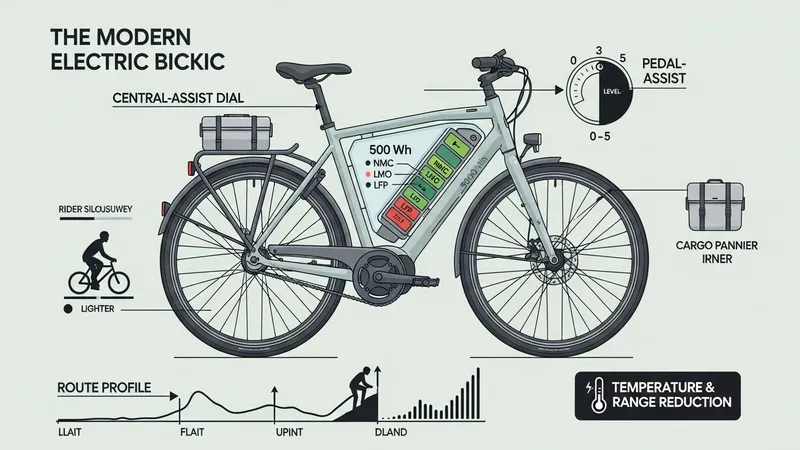
Range estimates based solely on battery capacity should be treated cautiously because rider-driven factors play a major role. Pedal-assist level selection, rider mass, cargo weight, route profile (flat versus hilly), and average speed can all change achievable distance per charge. Environmental factors such as low temperature can reduce effective battery capacity and increase internal resistance, often leading to reduced range under cold conditions. Manufacturers or independent testers may provide range guidance, but individual conditions typically produce different outcomes.
Charging characteristics and lifecycle considerations are part of pack management. Charging times may vary with charger power and pack acceptance rate; slower, lower-heat charging often promotes longer cycle life, while rapid charging can increase thermal stress. Battery lifetimes are frequently described in cycle counts—typical consumer packs may often deliver several hundred cycles before notable capacity decline, and storage at moderate state-of-charge and temperature can slow degradation. Battery management systems help protect cells from overcharge, deep discharge, and unsafe conditions.
Safety and transport considerations around battery packs are relevant for daily use and for when packs are shipped or carried. Many jurisdictions have rules for transporting lithium battery cells and for airline carriage that emphasize state-of-charge limits and packaging. For routine operation, following manufacturer guidance for charging, storing, and handling packs may help maintain performance and reduce risk of premature failure. Understanding the links between capacity, charging practice, and environmental conditions aids realistic planning for trips and charging needs.